Nonideal solutions
Earlier in the Solutions topic we touched a bit on nonideal solutions. I'd like to touch on how there is a fundamental aspect of ambiguity in the ionic activity and the overall placement of the ladder. The "single ion activity problem" is a well-known issue for ion chemistry and I just want to re-explain how it appears with the 's (in short, it affects but not ).
To be specific, we are concerned with cases where solutes deviate from an ideal-dilute logarithmic dependence on concentration. This is commonly captured as an activity , or an activity coefficient that acts as a fudge factor on the concentration. The electrochemical potential (traditional) and equivalently species voltages are decomposed as so:
(for constants )
(for constants )
for reference molality . I'm going to use molality in this topic just to match the chemists' preference,[1] but the arguments here apply to other concentration measures too.
The expectation is that when all solutes' concentrations go 0, then should approach 1 for all solutes. This is a physical/definitional convention: first, by statistical mechanical arguments we know is guaranteed to converge to a finite constant at low concentration provided that the species is actually present in solution as independent solute particles with concentration (i.e. that it neither dissociates nor associates).[2] We force that constant to be 1 by simply choosing values to make it so (in language we choose the spacing between values).
I'll call out a few clarifications:
Ideal-dilute means all ions are dilute: If any solute's concentration is significantly nonzero, then all may be , even for other solutes that themselves are infinitely dilute. The other dilute solutes will still behave ideally dilutely for low concentrations, however they will start out with . This reflects that they are dilute in an effective "new solvent" that is not the original pure solvent that was used to define . E.g. if we add dilute to water with a preexisting concentration of , then .
On molality/molarity: In water, the molal and the molar are practically identical, because is practically the same as . In other solvents though you'd have to separately define and the molar , as well as distinct activities and . But in all cases, even in water, the molal activity coefficient is not the same as the molar activity coefficient; to avoid confusion we will not use the molar activity coefficient ever.
Ideal mixtures vs. ideal-dilute: In chemistry there are two kinds of idealized solution. In an ideal mixture, the solute and solvent chemical potential both vary exactly with the logarithm of mole fraction. This reflects a case where solute-solvent, solute-solute, and solvent-solvent interactions all have the same character, and it corresponds to Raoult's law for both the solute and solvent. That is distinct from the ideal-dilute form, which we are interested in, which represents a case where solute particles may have very messy and irregular interactions with the solvent, yet all the dilute solute particles are independent from other dilute solute particles and thus behave (entropically) like an ideal gas. This leads to the solutes following Henry's law, though interestingly it remains guaranteed that the solvent follows Raoult's law in this case too.[3]
It does matter: ionic nonidealities are strong
Should we really care about nonidealities? Yes! In fact ions depart from the ideally-dilute case already at surprisingly low concentrations (e.g., in water), at least compared to non-ionic solutes which might only depart after .
Ions show early nonideality due to "ionic atmosphere" effects, i.e., how ions screen their fellow ions at medium range distances. This represents a form of correlation between the positions of ions, which violates our ideal-dilute assumption that the ions are moving around independently of each other. The crucial (and robust) effect of ionic atmosphere, as encountered in Debye–Hückel theory, is that the activity coefficients of ions deviate proportionally to the square root of concentration, , where is the ionic strength, a weighted sum of all ionic concentrations. By comparison, with non-ionic solutes the leading order deviation of activity coefficient is in the first power of concentration.
The leading order of the ionic atmospheres effect is actually simply computable, and is what causes the initial gradual bending downwards in that we saw in our NaCl plot. Repeating it here:
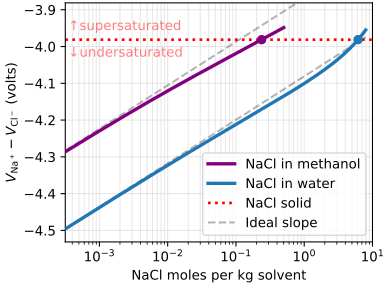
value for salt dissolved at varying concentrations, for two solvents: water and methanol. [source]
There is a lot more that can be said about the microscopic details.[4] But really, the main point is that nonidealities readily manifest with ions at the usual concentrations seen in experiments. So, we really ought to care about the nonidealities of ions!
That said, being off by a factor of 2 in the activity of an ion might only correspond to a voltage error of , so for imprecise work, electrochemists can often get away with ignoring the nonideality. And due to the ambiguities in activity (discussed next), it can be annoying to properly incorporate nonideality.
The fundamental ambiguity of ionic activity
You may have heard that single-ion activities are ill defined, or unmeasurable; or, that only mean ionic activities can be measured. Let's talk about why that is the case, first in the language of the 's.
Suppose we have solution of specific composition, with various ions and solutes, at known concentrations . Through careful measurements and comparison to the nearly-pure solvent case, we have determined a set of activities and/or activity coefficients that describe the nonideality in our solution. All seems good, but our conclusion is non-unique, and there are other sets of that equally well describe the nonideality!
Ion activity ambiguity in the language of
The problem is that our thermodynamic measurements really only have access to 's, and the position of the ladder is only inferred.
The following transformation shifts the ladder to , and produces an equally valid collection of values and :
for any value of . For example, with we can lower the entire ladder by 59 mV, and multiply and for ions by ×10, multiply and for ions by ×0.01, and so on.
This is a severe form of arbitrariness, not merely a simple one-time offset but instead a continuum of offsets. We can choose a different value of for each kind of solution in each set of conditions. If we have a curve of some ion's activity vs concentration, we can turn it into any other curve by making vary with concentration (and adjusting all other ions' activities accordingly). This ambiguity seems troublesome, but on the other hand, it is purely a mathematical obstacle that we have created by insisting on relating nonideal solutions to ideal solutions. (The interactive figures in References & cells put exactly this freedom on sliders, one per solution: the wires and every hold still while the ladders slide.)
As we'll see below, this ambiguity gets addressed in practice by:
- focussing on activity combinations that are unaffected by the ambiguity, or,
- adopting an ion activity convention.
Mean activity / mean activity coefficient
There are certain products of ion activities or ion activity coefficients that are overall charge-neutral, and so the arbitrariness cancels out. That makes them unambiguously measurable. These are known as mean activities or mean activity coefficients. For example, products like , or are measurable. Often we talk about the logarithms of these quantities.
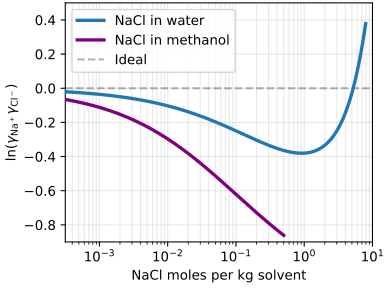
Log of mean activity coefficient, , for salt dissolved at varying concentrations in two different solvents: water and methanol. This matches the shown above (however this contains strictly less information since it does not include the standard state offsets; in chemistry these are offloaded to the solubility product ). The deviation of each curve from 0 is nonideality: we can partly blame this nonideality on one ion or the other, but the attribution is thermodynamically ambiguous. [source]
These relate to species voltage differences like and , respectively. In general a measurable mean activity has the form
for some weights , satisfying:
The same condition applies for a mean activity coefficient .
Let's prove this. We can perform the -transformation on and see that:
Therefore, in order to be insensitive to , the weights must be zero-sum. , and likewise .
A mean activity like this corresponds to a sum of differences, i.e., a linear combination of voltages with zero-sum weights :
Here, is also insensitive to the overall offset (including arbitrariness) because it has zero-sum weights, so it is a constant for given solvent and 's.
On binary salts: usually mean activity coefficients are described only for binary salts.[5] Here's how that works: suppose we have a compound and we add it to the pure solvent with formal molality . It dissolves completely, and we assume that it formally dissociates into ion molalities and (and the combination must be charge neutral hence ). After some math, we then have:
where is the offset, is the ideal slope, and is the mean activity coefficient as it is commonly defined:
(In the case of , this is ). Per the above discussion this is indeed a charge-neutral combination with .[6] Anyway, this gives us the ideal curve of , and also shows that the deviation of from ideal is exactly proportional to . It is also possible to define a mean activity and mean molality though I find those can be more confusing to interpret.
The preceding discussion shows however that many other activity combinations are also charge-neutral, such as , and they do not have to relate to any particular salt compound nor do they refer back to any formal assumptions about dissolution.
How does one actually measure a mean activity? The classic route is a junction-free cell whose voltage consumes exactly the charge-neutral combination: the Harned cell of References & cells reads straight off a voltmeter. The same cell, run toward the dilute limit where all by definition, is also how the standard levels get pinned in the first place: subtract the ideal Nernst slope and extrapolate to zero concentration.
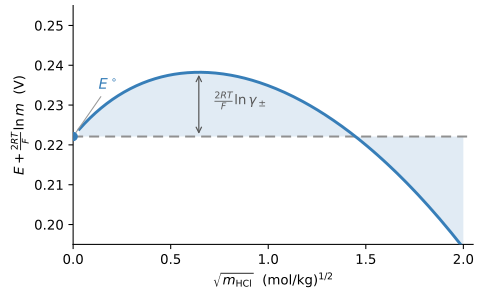
The classic extrapolation (Harned & Ehlers, 1932–33; the Pitzer fit for stands in for their data points): the measured Harned-cell voltage with the ideal Nernst slope subtracted, plotted against so the Debye–Hückel limit comes in straight. The intercept pins , equivalently the ladder spacing; the shaded gap from the flat line is at each concentration, a mean activity coefficient measured with no convention in sight.
Activity-fixing conventions
Now, let's touch on some various conventions that are used to set ionic activities. In general these conventions are all regarded as "extrathermodynamic", based on some approximate microscopic argument about what the real activity ought to be, or something equivalent to that. The Debye–Hückel theory is a good start but it only gets you so far.
Bates–Guggenheim Convention: this assigns a specific activity function for ions as a function of their concentration. It is used in the analysis of a primary pH standard (the Harned cell) where fixing leads to fixing .
MacInnes convention: this assigns equal activity coefficients to the potassium and chloride ions: . It appears to be popular for tabulated ion activities that are fitted to empirical Pitzer equations.
Guggenheim's symmetric convention: for a binary electrolyte, simply split evenly: . Defensible wherever the charge-symmetric ionic atmosphere dominates; it is the split behind the voltaic-cell measurements underlying the "absolute" electrode potential (References & cells).
Liquid junction convention: sometimes it is assumed that the liquid junction potential (see below) is zero between two solutions, or otherwise takes on some expected value. This assumption is valid provided we redefine activities to make it so.
Real- conventions: the conventions above fix activities directly, but one can also work backwards from an electrostatic potential. A solution offers several candidate definitions of a microscopically 'real' (the mean inner potential familiar from electron microscopy, various cavity potentials, a TATB-style symmetry split), and committing to any one of them imparts a 'real activity' convention automatically: whatever part of is not is then booked as chemical. We will meet the same trade from the other direction shortly, where adopting an activity convention quietly redefines .
As for the famous TATB hypothesis itself: its actual habitat is one level up from this list, splitting standard-state transfer energies between different solvents, with within-solution activity corrections extrapolated away before it is invoked. Its proponents do not offer it as an activity fixer inside any one concentrated electrolyte, and with reason: the twins' designed symmetry is against the solvent, not against a concentrated ionic environment. The twins, and the candidate real 's generally, get their proper treatment in under the microscope.
These conventions all agree in the semi-dilute regime, where nonideality is dominated by the long-range ionic atmosphere and is genuinely symmetric between ions, but they diverge beyond it. Some real numbers for (simplified Pitzer model, expressed as -ladder shifts ): the two chloride-anchored conventions, MacInnes and Bates–Guggenheim, track each other within all the way to , but the symmetric split parts from them by at and at — in terms, disagreements of tens of percent. This might be disastrous (in precision metrology) or negligible (in battery research). Anyway, regardless of which convention is chosen, and regardless of the accuracy of their motivations, the convention choice has no impact on actual observable results.
Of course, the conventions are technically all incompatible. This is the source of some difficulties with precision usage of single-ion activities, such as pH which is notionally defined as . Precise pH values are actually defined operationally in a way that traces back to the Bates–Guggenheim convention. In other conventions, the value of will then deviate from pH (the deviation being of order 0.1 for concentrated acids around 0 pH). Unfortunately the pH activity convention is uncommon in other contexts, so it is almost always imprecise to make a pH measurement and then to compute .
Comparison: ionic activity ambiguity in standard chemistry of ions
In the standard chemistry of ions we notionally decompose the electrochemical potential as so:
Here, we have:
- , the fundamental thermodynamic chemical potential for an ion, which like can be accessed (aside from a single, global electrostatic offset).
- , a fixed value for solute in given solvent; it has nothing to do with nonideality and is purely a function of the local influence of a single, solitary solute on an otherwise pure solvent.
- , an inaccessible yet supposedly physical quantity, something independent of the thermodynamics.
It seems this should leave no ambiguity at all: everything besides activity is determined, therefore this equation uniquely must determine physical ionic activity . And so it is often argued that we could know the "true " if not for the "true " being inaccessible.
But this raises a contradiction if we choose an activity convention. We are then setting , and therefore we are setting (up to a single, constant offset per solvent). If is subjective then so must be, which totally contradicts the idea that is a real quantity.
The answer to this paradox is that the above equation is reinterpreted into a redefinition of based on a practical convention for 's. The true is in fact abandoned.
In other words, we should really say that is decomposed as so:
which serves as a definition of , an "electrostatic potential" that no longer needs to correspond to any precise physical electrical property. The flexibility in choosing an activity convention (i.e., defining the concentration-dependence of regardless of what is actually doing) basically takes advantage of the -shifting property described in the previous section.
In summary: When you adopt an ion activity convention, then no longer represents an electrostatic potential.
There has actually been a huge amount of debate about the problem of single-ion activities and whether they are merely operationally difficult to access, or they are fundamentally ill-defined. My viewpoint, which I'll argue more in my later topic about , is that yes, we can actually in principle establish a true average electrostatic potential , but there is a deeper problem in that is not even meaningful in this context. I.e., the calculation of for any ion has no physical meaning. Hence, there is no physical meaning to the decomposition of into . Even in an omniscient computer simulation with knowledge of the true , a calculation of is artificial and merely ends generating one activity convention among many. The practical activity conventions are preferable since at least they are experimentally useful.
Liquid junction potentials and electrode potentials
The conventional brings its conventional into the standard formulas. The Nernst equation reads electrode potentials off single-ion activities, so the tabulated is (not ), with pinned to the SHE rung of the ladder; and the liquid junction potential in the cell bookkeeping is likewise the practical step , carrying both solutions' activity conventions inside it, rather than any "true" . This whole story is played out operationally, on sliders, in References & cells: the /LJP decomposition reshuffles as each solution's convention is dragged, while the measured wire-to-wire never moves. (The true is objective enough as a description of the junction's real double layer, but ions do not care: is not the step any ion experiences, and between different solvents is even contaminated by the solvents' atomic core potentials, which no ion ever sees. More in under the microscope.)
Relating to
Let's say we are using the same activities for our framework as in our traditional framework. We then find that
Since the are constants, then this means actually sits fixed at some position on our ladder and they move rigidly together.
This exposes a second convention in the decomposition, beyond the activity choice: the list is not given to us a priori, so energy may be reallocated between and the with nothing physical (no , , or ) changing. This is isomorphic to freely choosing where sits on the ladder. That offset freedom is charted in offsets galore; here we keep to the activity problem.
Concentration ambiguity
It is worth mentioning that there is another unrelated ambiguity that affects activity coefficient but not activity , and this has to do with the ambiguity in how we count ionic solutes. This is not particular to ions, as it affects non-ionic solutes too.
As a classic example, consider copper (ii) sulfate () dissolving into water. If you look up data for this, you will see that the mean activity coefficient plummets rapidly towards zero as the salt concentration is increased. But this is largely because we are formally counting the and concentrations as if they are fully dissociated free ions, but in fact they are readily forming ion pairs. If we instead count the "paired" aqueous as a separate species, then it will reduce our count of and ions. But this mental recounting cannot affect the actual 's or activities, so the activity coefficients must increase to compensate for a reduced count of free ions. If we were to recalculate and re-plot based only on free ion concentrations, we'd get a curve sitting much closer to 1.
Similarly, in describing the activity coefficient of aqueous sulfuric acid , we might describe it as dissociating into and two , which will be reasonable at dilute concentrations. At high concentrations, the 'pairing' of one and one into becomes significant (and becomes dominant for pH of 2 and below). In the Solutions topic data table for aqueous ions, we have data for both and ; whether we included or not would strongly impact the required values of both and .
Basically, this is the distinction between a formal/nominal solute concentration, as compared to a "real" free solute concentration. It can be advantageous to explicitly include more forms of solutes in our analysis (like the ion pairs), which can help extract out annoying behaviours from the activity coefficients. On the other hand, having the extra forms also adds more free parameters, and may not simplify matters in highly concentrated solutions that are fully nonideal.
No solvation ambiguity
It is important to remind that all the standard states of solutes, such as and , will always refer to 'fully solvated' ions: the ions are ideally dilute, being far from other solutes, but they are subject to arbitrarily complicated and real influence of the solvent medium. It is normal that an ion will exert a severe disturbance on the solvent around it, and that disturbance is fully included in the definition of the standard state.
For example, when we refer to an ion we are always referring to the total concentration of a lumped group of species: , , , and so on. The actual concentration of 'naked proton' is going to be a tiny fraction of the lumped concentration.
Insofar as counting, there is not much point in trying to distinguish the differing hydration levels as distinct species. First, it would be hard to distinguish them. Second, we would have to actually redefine the existing standard state positions and add new positions. E.g., would have to be greatly increased to reflect the rarity of naked protons, and the 'actual activity' would be tiny (very inconsistent with the usual pH definition!).
Still, as we approach more and more concentrated solutions it is important to remember that our standard states refer to ions bathed in infinite solvent. We expect nonidealities not just because solutes are interacting, but also because the solutes have less and less solvent available to them, yet we are still referencing them to a fully solvated form.
(And despite all of this, the thermodynamic quantities , , etc. are all distinct and well defined (each one being incrementally offset by ), even if they don't have distinct counts / standard states. If we had a semipermeable membrane that somehow only permitted exact ions to pass, then is the voltage that would equilibrate across the membrane!)
Takeaways
Ionic solutes tend to be nonideal, which begs for them to be treated with activities or activity coefficients. But, the concept of single-ion activity can be surprisingly subtle. There is a fundamental ambiguity which requires us to specify some kind of convention, and since there are many different slightly incompatible conventions, things can get imprecise.
For activity coefficients (but not activities), there is also the issue of how we are counting solute concentrations, and in particular whether we are including dissociated / associated forms explicitly or implicitly.
NEXT TOPIC: Chemical capacitance matrices
If we misidentify the solute particle, then a van 't Hoff factor appears that multiplies the result of the logarithm. ↩︎
Interestingly, Henry's law (for dilute solutes) automatically implies (via the Gibbs–Duhem relation) an effective Raoult's law for the solvent's chemical potential, and this why colligative properties like osmotic pressure are guaranteed. In other words, Raoult's law is guaranteed for the solvent provided the solutes are dilute, and that has nothing to do with ideal mixtures nor any of their associated concepts like "entropy of mixing" or "solvent dilution"; chemistry textbooks are often not clear on this point. ↩︎
For example, if you have an ionic solution and add a new dilute ionic solute, then it will not significantly change and its effect will be first-order too. Logically, this must apply for pure water which has a preexisting nonzero ionic strength due to spontaneous autoionization. That means that technically all dilute ions added to water have varying to first order in concentration! But the linearity only holds for tiny concentrations up to , after which the new ion is going to significantly add to . ↩︎
LibreTexts "Activities of Electrolytes - The Mean Activity Coefficient". ↩︎
These weights are and , and indeed because of that neutrality . ↩︎