Solutions
In the earlier topic about reactions, we saw that solid in equilibrium with a solvent (such as water) sets a fixed . But that is for a fully saturated solution. What happens when we only have a tiny amount dissolved? How does depend on the concentration of dissolved ?
To anchor the discussion, here are some fairly accurate modelled curves:
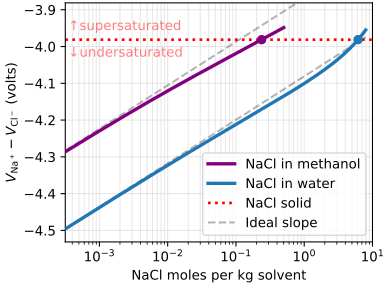
value for salt dissolved at varying concentrations, for two solvents: water and methanol.[source]
Note the roughly linear dependence on the logarithm of concentration (the "ideal slope" in the figure). This is guaranteed in the dilute limit, for a fundamental entropic reason: each solute particle's position becomes independent of the others.
The saturation behaviour is worth noticing too. As more salt dissolves, climbs, and a solution pushed above the solid's fixed value is supersaturated: it has become favourable for the excess to precipitate back out. Saturation is precisely where the solution's value meets the solid's.
Although the dilute limit is only approximate, it gives us a starting point for more complex questions (what happens when many species of ion are present?) without first laboriously measuring thermodynamic data over every composition.
Ideal ionic voltage in dilute solutions
Statistical mechanics tells us that a dilute solute's electrochemical potential breaks into three parts:
The first term is written as the electrostatic energy of the ion's charge at a local potential . The second, the standard internal chemical potential , is fixed by the ion's chemical identity and the way it disturbs its solvent (its solvation shell); it does not depend on concentration.[1] Only the third, entropic term does, sinking logarithmically as the solute is diluted. Here is the molar concentration (moles per litre, also called molarity), is a fixed reference, and the remaining symbols are the molar charge (coulombs per mole) and the gas constant times temperature (joules per mole).
The split between the first two terms is partly conventional, since it turns on how one defines the ambiguous , so rather than carry them separately we fold them together. Dividing through by the molar charge to cast everything in volts, and gathering the two concentration-independent terms into one, gives
The new quantity is the standard species voltage. You can think of it as the voltage the ion would carry at the reference concentration , sort of;[2] what it marks on the diagram is the reference level that the carrier's floats away from, the gap between the two reading as concentration. Like it is not pinned to an absolute value, floating with the electrical state of the solution, but as we will see its differences from ion to ion are rigid.
Concentration can equally be measured as molality (moles per kilogram of solvent), giving the same ideal form with . The molal and molar standard states differ only through the solvent density,[3] which for water is negligible. The plot above used molal units; I will mostly prefer molar and switch when convenient.
Ideal-dilute salt water
Returning to our salt-water example, we then have:
where is the concentration of either ion. This gives that characteristic slope we saw in the plot above. Also note that is a constant for water in our conditions; cancels out of the difference, so it does not depend on that ambiguous quantity. When discussing solutions we can draw each as its own line alongside the :
This is the first figure to actually draw lines, so a word about the artwork. Each is a thinner line in its ion's colour, with a faint hatching on its concentrated side, the side the carrier floats toward as the concentration grows (above for the cation, below for the anion, following the sign of ). A carrier level in the clear is below standard concentration; one that enters the hatching has passed . The look is borrowed deliberately from the band edges of semiconductor band diagrams, where a Fermi level entering the hatched band means degeneracy; the next topic develops that connection properly. One caution, though: a rung is a more abstract object than a band edge, a pure concentration reference.[4]
Ionic standard states are a floating ladder
Although the individual float, the differences are invariant properties of the pure solvent (they also vary with temperature and pressure, but that won't matter for our purposes). Here is a selection of values for water at standard conditions (25 °C, 1 bar):
I call this the standard state ladder for water. As the electrical state or solute composition of the solution changes, the may ride up and down, but only all together, every rung locked to the others.[5] The are the mobile part: each carrier hangs its own logarithmic, concentration-set distance off its own rung, so their relative positions shift freely with composition. That is also the answer to the many-ion question above: however crowded the solution, there is one rigid ladder underneath and one floating carrier level per ion. The data page tabulates the rung values used here, along with the procedure for obtaining them from standard ionic Gibbs energies of formation ( values).
In effect, the standard state ladder is a stand-in for the electrostatic potential , with each rung also absorbing the ion-specific parts: the local electrostatic environment that particular ion feels, its chemical structure, the way it disturbs the solvent around itself. It also stretches the band-edge analogy in a pleasing direction: where a semiconductor's two band edges frame a single band gap, a solvent offers a whole ladder of "band edges", with a fixed "band gap" between any pair of rungs (the above being the one framed by and ).
Multiple ions and pH
Back in Reactions we drew two separate figures for water: an acid pair, and tied together by autoionization, and a salt pair, and tied by dissolving solid, and we left open how the two share one axis. Here is the answer: put all four ions in one solution, and there is one rigid ladder underneath with each carrier hanging off its own rung by its own concentration.
Dilute salt water, all four ions. The two sliders add neutral substances: table salt, and a dose of acid or base ( or ), with the resulting pH as readout. The salt slider floats the / gap freely, while the acid/base slider slides the / pair rigidly (the ⇌ is water's always-equilibrated autoionization), up with acid, down with base.
Where is the pH in this picture? It is a literal distance. In the dilute regime ,[6] so the carrier hangs below its rung:
and likewise hangs above its own rung . Autoionization pins the carrier pair apart while the ladder holds their rungs only apart, leaving of dilution that the two carriers must share between them, however acid and base split it: , drawn as geometry.
Spatial variations
So far the ladder has hung in a single well-mixed solution, and it would be easy to walk away thinking of the as fixed properties of that solution, like its density. They are not. The ladder floats with the local electrical state, and nothing obliges that state to be the same everywhere. The gentlest demonstration: take the ideal-dilute salt water from above and drive a steady current through it.
The same dilute solution as in the earlier figure, now a spatial slice (far from any electrode) carrying a uniform current. The composition is identical at every point, yet every level slopes: each tilts because current is flowing through resistance, and the ladder tilts right along with it. Notice what does not change: the rung spacing stays rigid and the concentration gaps don't budge. Positive current flows rightward, downhill.
This uniform tilt is the tamest move in the ladder's repertoire. In later topics it will bend where concentration gradients pile up (basic transport), swing sharply across the few nanometres beside a charged interface (basic electrostatics), and step outright where the medium itself changes, since a different solvent or phase carries its own ladder (charge neutrality and mass action). For now the point is only that the ladder is a living thing rather than a fixed backdrop: rigid in its spacings, free in its motion.
Activities and nonideality
The ideal-dilute law holds only while each ion can ignore the others. Beyond that, chemistry keeps the logarithmic form and folds every deviation into an effective concentration, the activity , defined precisely so that
holds exactly, with the very same standard we met above. In terms,
with the standard state pinned by requiring in the dilute limit.[7]
There is a catch, and it is a big one. We can measure ; we cannot directly measure , , or . In the ideal-dilute regime this didn't matter, since the concentrations pinned every gap. In a nonideal solution, nothing any longer fixes where the ladder sits relative to the carriers: its rung spacings are still rigid solvent properties, but its overall position against the becomes a pure convention, settled afresh by every solution of every composition. This is what chemists mean by the dictum that only mean ion activities are measurable: the measurable combinations are differences like , from which the ladder's position cancels out. The appendix topic on nonideality works through the consequences.
What none of these choices can reach is itself. Concentration measure, reference value, single-ion activity convention: each merely shuffles bookkeeping between and , while the physical total (that is, the observable ) stays fixed. Offsets galore keeps the full scoreboard of such conventions, where the activity emerges as the traditional framework's true rival to : the dimensionless buys immunity from every global convention at the price of that severe per-composition local one, while makes exactly the opposite trade.
Takeaways
A dilute ion's species voltage sits a logarithmic distance from its standard species voltage , the distance set by concentration through . The float with the electrical state of the solution, yet their differences form a rigid ladder fixed by the solvent; once the solution is no longer dilute, the concentration generalizes to an activity, at the price of a convention that unmoors the ladder from the carriers while leaving every untouched. This same structure, a carrier floating logarithmically above a standard-state level, turns out to describe the electronic carriers in a semiconductor every bit as well, and that is where we go next.
I label this term the offset rather than "chemical," because neither word quite fits. It is not purely chemical: quietly absorbs the ion's solvation electrostatics (the Born energy and more) and local entropy alongside any chemical binding. Nor is it the full "chemical part," which a chemist would take to include the activity term as well. It is really just the fixed, ion-specific piece left once the bath potential and the dilution entropy are set aside, and even its boundary with is a convention rather than a physical fact. I make this case in under the microscope. ↩︎
Only "sort of": the equation says merely that coincides with when . Physically adjusting a solution's concentration would also disturb its electrical state, carrying both levels off to some new meeting point, so the drawn at the current state is not a promise about a modified solution. ↩︎
Equating the two forms gives for solvent density . For water ( at 25 °C, 1 bar) this is a negligible , though it can matter in other solvents. The two measures also describe slightly different ideal behaviour once the density varies with concentration, but that happens only in the concentrated regime where both logarithmic forms already fail. ↩︎
A band edge marks the energy of an electron at rest; a rung marks no such thing for its ion (nobody has a very good handle on what the energy of an ion "at rest" in a solution would even be). The semiconductors topic returns to this distinction from the other side. ↩︎
Within one solvent, that is: a different solvent has its own ladder, and where two solutions meet or a medium grades between them the ladders can step. See inhomogeneities. ↩︎
Strictly, pH is defined through the single-ion activity , exactly the convention-burdened object that the nonideality appendix wrestles with; in the dilute regime the distinction evaporates. ↩︎
The concentration measure itself hides a convention here: switch from molarity to molality, or change the reference values, and the and every shift in compensating ways. A classic source of confusion; see Adam Přáda's blog (2019), "On chemical activities". Chemistry also likes to repackage the activity as concentration times a dimensionless activity coefficient, which inherits all of these troubles and adds a few of its own; I'll keep coefficients out of sight until nonideality needs them. ↩︎